
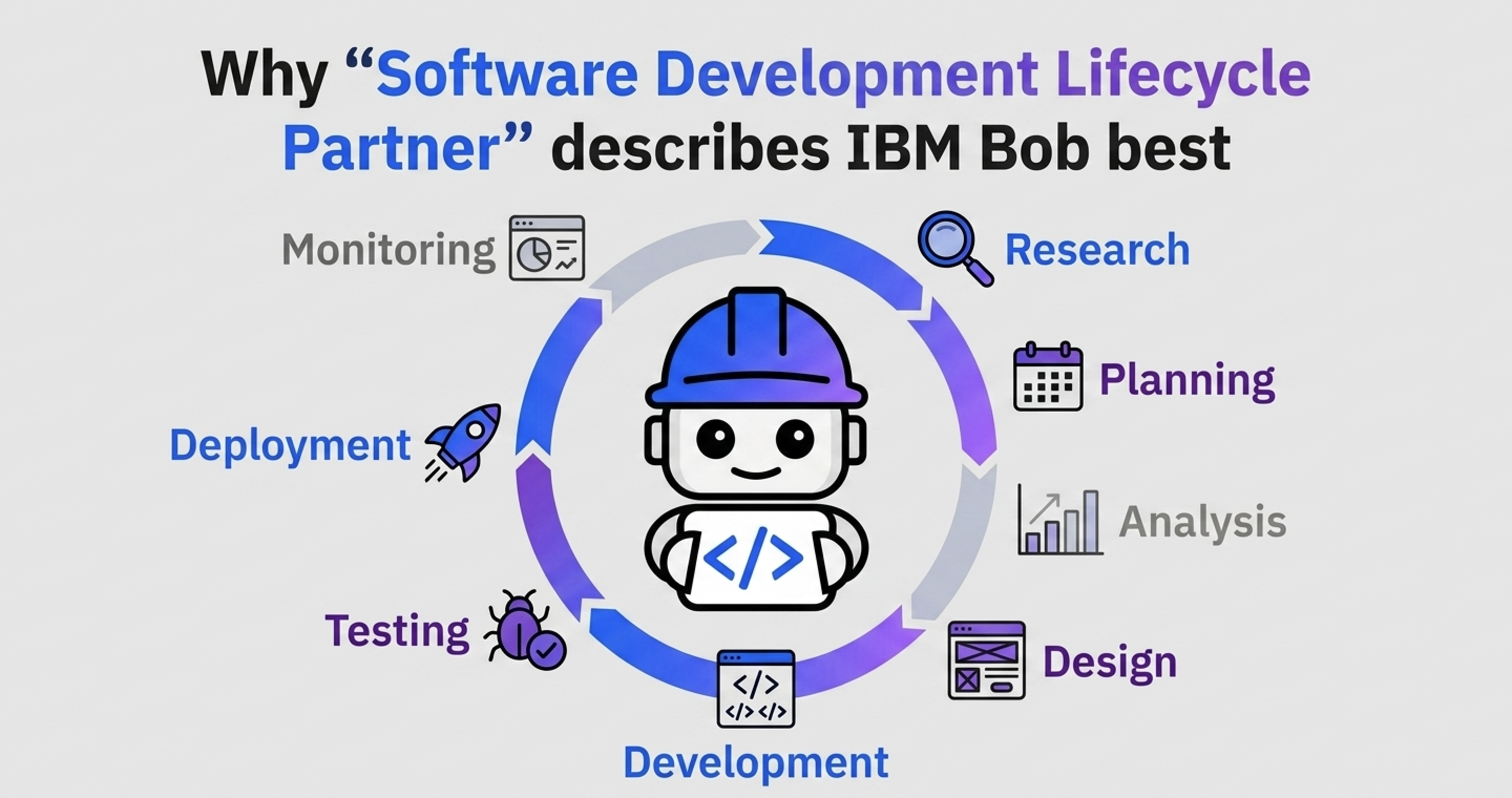
The tagline ‘Software Development Lifecycle Partner’ is a mouthful, but it describes well the key benefits of IBM Bob. This post explores the reasoning behind this concept and why it matters for the future of software development.
Here is how the documentation describes IBM Bob:
IBM Bob is an AI SDLC (Software Development Lifecycle) partner that augments your existing workflows and helps you work confidently with real codebases.
The tagline ‘Software Development Lifecycle Partner’ contains two parts:
- Partner -> The role of developers needs to change and is changing
- Software Development Lifecycle -> AI needs to be leveraged in all SDLC stages, not just for coding
This post describes why these two aspects are key how to do the next generation of software development.
Executive Summary
Artificial Intelligence is transforming software development faster than any tooling shift before it. Code can be generated in seconds. Applications can emerge before mockups are finished. And yet, enterprise delivery is slowing down, not speeding up.
This post argues that the problem is not AI itself, but how it is applied. Fully autonomous approaches like Vibe Coding optimize local development for speed while creating systemic failure across the Software Development Lifecycle. The winning concept is emerging instead as Spec-driven Development, where AI agents deliver autonomy without sacrificing trust or human ownership.
IBM Bob was built to enable exactly this concept, not as a code generator, but as a Software Development Lifecycle partner: advancing how software is conceived, built, verified, secured, modernized, and run in the enterprise.
The Paradox of AI in Software Development
AI has undeniably changed the inner loop of development. What once took days - spinning up boilerplate, exploring APIs, writing tests - can now be done in minutes. Many teams no longer start with mockups; they start with running code.
This has created enormous excitement. Developers believed AI would make them dramatically more productive. Leaders expected faster delivery, better quality, and lower costs. And yet the paradox is striking:
- Developers feel faster
- Enterprises deliver slower
In real-world, production-sized codebases, teams using AI often take longer to complete issues, even while believing they are moving faster. Research from mid 2025 indicates a workflow gap. In complex, real-world codebases, enterprise delivery is actually taking 19% longer than before the AI boom while developers expected a 24% productivity boost.
The bottleneck has quietly shifted. Writing code is no longer the constraint. Several other stages of the SDLC are.
The Vibe Coding Wall
At the beginning of 2025, fully autonomous agent workflows captured the imagination of the industry. The promise was seductive: describe what you want, let an agent build it end to end.
This Vibe Coding model maximizes agent autonomy, but at a cost that only becomes visible later:
- Fragmented architectures
- Inconsistent patterns
- Undocumented decisions
- Technical debt that accumulates invisibly
- Humans who no longer understand why the system works, or doesn’t
Eventually, teams hit what many developers now call the vibe coding wall: a moment where progress stops completely because reclaiming ownership requires painful, manual investigation across hundreds of files. Sometimes the only way forward is a rewrite.
Speed without control is not acceleration. In the enterprise, it is risk.
Developers become Supervisors
This leads to the first core insight professionals need to internalize: The role of the developer is changing, from primarily writing code to supervising intelligent agents. This is not about replacing developers. It is about elevating them.
Supervising agents means:
- Deciding what should be built and why
- Defining constraints and success criteria
- Guiding architectural decisions
- Reviewing outcomes rather than keystrokes
- Retaining accountability for quality, security, and compliance
IBM Bob is explicitly designed for this future. It treats AI not as an autonomous replacement, but as a collaborative partner whose autonomy is intentionally governed.
Holistic SDLC Approach
The second core insight is equally important: Improving software delivery requires a holistic SDLC approach, not a narrow focus on coding.
Coding accounts for roughly one‑third of a developer’s time. The rest is spent on planning, reviews, testing, security checks, CI/CD troubleshooting, infrastructure concerns, governance, and operational readiness.
When AI only accelerates coding:
- Pull requests grow larger and harder to review
- CI pipelines become the new bottleneck
- Security reviews are overwhelmed
- Observability gaps surface in production
- Organizational friction increases
This explains why enterprise delivery slows down even when developers feel faster. IBM Bob was built around the assumption that the SDLC is not obsolete, it is dysfunctional. And dysfunction must be addressed end to end.
IBM Bob provides capabilities across the entire lifecycle to solve the workflow gap:
- Upstream (research and design), for example: Bob analyzes massive amounts of unstructured user feedback and research results to synthesize the top customer pain points, informing the requirements phase.
- Midstream (security and compliance), for example: Through Shift-left security, Bob identifies vulnerabilities during the implementation phase, preventing costly re-work during the deployment stage.
- Downstream (monitoring and maintenance), for example: Bob assists in production observability by analyzing logs and suggesting root causes for alerts, rather than just presenting a dashboard of symptoms.
Spec‑driven Development
The emerging answer is spec‑driven development (SDD). The goal of SDD is not to reduce autonomy, but to balance three forces:
- Human ownership: Do humans retain control over the system’s direction and state?
- Agent autonomy: Can agents make meaningful progress independently?
- Project trust: Is the system correct, maintainable, understandable, and safe?
Vibe coding maximizes autonomy while collapsing trust and ownership. Spec‑driven development intentionally maximizes autonomy without sacrificing either. IBM Bob operationalizes this balance across four distinct stages.
Stage 1: Requirements
The requirements stage is intentionally owned by humans. Here, Bob acts as a thinking partner, not an executor:
- Capturing context through structured brain dumps
- Extracting implicit assumptions
- Organizing reference material
- Clarifying expected outcomes
Bob’s planning mode and context management allow agents to operate later with confidence, without guessing. This is slow work by design. And it pays for itself many times over.
Stage 2: Spec
The spec is the most important artifact in spec‑driven development. It is:
- Detailed enough to guide implementation
- Intentional about validation and review points
- Broken into phases with clear success criteria
- Owned by the human, not the agent
Note that the specs must not be too detailed. If too detailed, you essentially write a program as in the waterfall age and you don’t leverage AI.
Bob supports this phase by:
- Drafting implementation plans
- Challenging assumptions
- Simulating edge cases
- Interviewing the human to confirm understanding
Humans own the specs and the implementation plans, agents refine them. This conversational refinement is where trust is built, or lost. Bob makes that dialogue first‑class.
Stage 3: Implementation
Only now does autonomy peak. Bob can:
- Generate code across repositories and languages
- Track progress against the spec
- Run tests and validations
- Pause automatically at predefined checkpoints
Guardrails, defined earlier, govern what can be auto‑accepted and what requires human approval. Developers supervise, spot‑check, and unblock. Agents execute. This is where productivity accelerates safely.
Stage 4: Verification
Before code reaches production, ownership must return fully to humans and teams, and trust must be reclaimed. Bob supports:
- Automated code reviews
- Pull request preparation
- Test coverage analysis
- Risk surfacing
But it does not replace:
- Manual review for critical paths
- Peer accountability
- End‑to‑end validation
In enterprise software, review is not bureaucracy, it is governance.
The SDLC is not obsolete
There is a narrative that AI collapses the SDLC into a single loop of intent and iteration. That approach works:
- For solo developers
- For prototypes
- For non‑critical systems
It fails:
- In shared codebases
- In long‑lived platforms
- In organizations where software is the business
- In regulated environments
IBM Bob’s philosophy is clear: AI should strengthen proven engineering disciplines, not erase them.
Why IBM Bob is different
IBM Bob stands apart not because it generates code faster, but because it was designed for enterprise realities: cost control, governance, platform depth, modernization at scale, and security that starts on day one. These strengths are not accidental, they are a direct consequence of Bob being built inside IBM, for complex systems that cannot afford failure.
That origin explains its strengths:
- Governance and transparency: making AI adoption sustainable
- Application modernization: AI that understands legacy reality
- Shift‑left security: security as a continuous capability
Plus in the IBM Dev Day Bob keynote, it was mentioned that IBM plans to provide an on-premises version of IBM Bob!
Governance and Transparency
One of the fastest ways AI initiatives fail in enterprises is through uncontrolled cost growth and opaque usage. When every task defaults to the largest model, and when consumption is invisible, innovation becomes financially unsustainable, and leadership loses trust.
IBM Bob approaches this problem differently. Bob is designed around intentional model usage:
- The right model for the right task, rather than the biggest model for everything
- Explicit tradeoffs between cost, latency, and capability
- Organizational guardrails that allow teams to move fast without overspending
This is reinforced through built‑in transparency:
- Bob includes an administrative analytics layer (Bobalytics) that provides visibility into AI usage patterns
- Token consumption (Bobcoins) is tracked and visualized at individual, and team level
- Leaders can see how Bob is being used, not just how much
The result is a critical cultural shift: AI is no longer a black box expense or an uncontrolled experiment. It becomes a governed capability, aligned with business priorities and budget accountability. For executives, this matters because sustainable AI adoption is not about limiting usage, it is about making usage visible, intentional, and trusted.
Application Modernization
Application modernization is where Bob shines. Legacy systems are large, multi‑decade codebases, poorly documented, deeply coupled to platforms, infrastructure, and business processes and often mission‑critical.
IBM Bob was explicitly built for this world. IBM is considering to offers three Application Modernization Premium Packages, each tailored to a critical enterprise platform:
- IBM Bob Premium Package for Java: Accelerates Java modernization, for example IBM WebSphere to Open Liberty, with safer upgrades, dependency analysis, and guided migrations.
- IBM Bob Premium Package for IBM i: Unlocks productivity for IBM i development, enabling modernization while respecting platform constraints and domain‑specific patterns.
- IBM Bob Premium Package for IBM Z: Optimizes mainframe modernization using platform‑aware AI that understands COBOL, PL/I, transaction systems, and performance‑critical workloads.
What makes these packages powerful is not just platform knowledge, but the shared enterprise foundation underneath:
- Prebuilt workflows and modes aligned to SDLC best practices
- Deep domain expertise embedded into agent behavior
- Seamless integration with existing IBM tools and systems
- Domain‑specific security controls
- Performance optimizations tuned for each environment
This is not modernization by rewriting. It is modernization by incremental, trusted transformation, guided by humans and accelerated by AI.
Shift‑left Security
As AI becomes part of the SDLC, security can no longer be something teams add at the end. Traditional approaches, where security lives primarily in deployment and operations, break down when code is generated faster than it can be reviewed. The industry term for the necessary change is shift‑left security.
IBM Bob operationalizes this shift:
- Security considerations begin during requirements and spec creation
- Architectural and compliance constraints are enforced during design
- Code generation incorporates secure patterns by default
- Automated checks run continuously during implementation
- Verification includes both automated and human review
Bob treats security as a first‑class participant in the SDLC, evolving alongside AI rather than reacting to it.
Next Generation SDLC
The future of software development is not about eliminating humans from the loop. It is about:
- Shifting developers from coders to supervisors
- Scaling autonomy through discipline
- Applying AI across the entire SDLC, not just coding
- Combining established practices with new AI capabilities
IBM Bob embodies this future. Not as a magic button. But as a trusted Software Development Lifecycle partner helping enterprises move faster without losing control. And in the enterprise, that is the only speed that matters.
So, what’s next?
Learn by doing. Try Bob!
For a complete end-to-end example check out the article Spec-driven Development with IBM Bob.
Special thanks to Gabe Goodhart and Rynne Whitnah for their guidance on spec-driven development.