
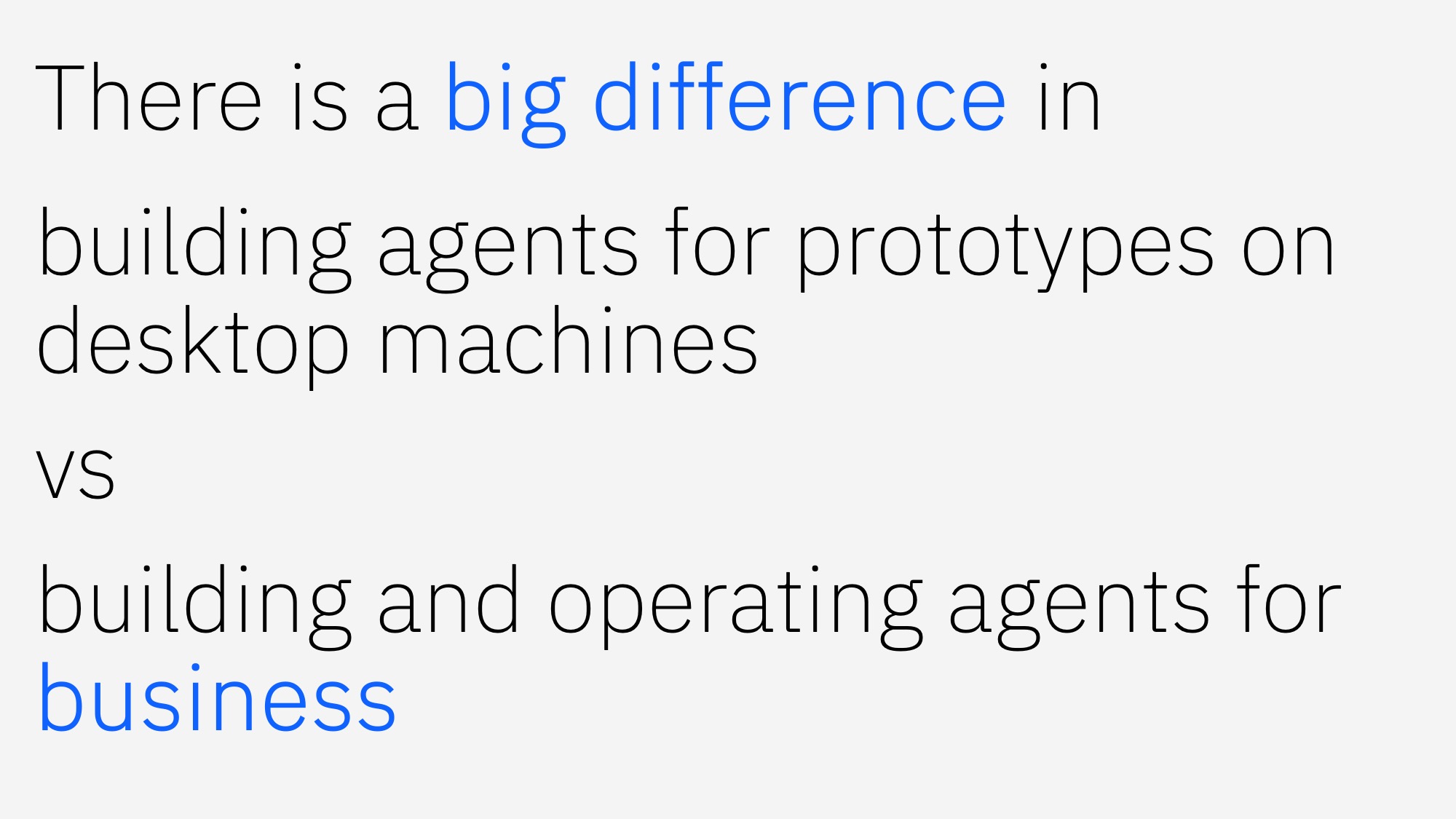
There is a big difference in building agents for prototypes on desktop machines vs building and operating agents for business. Watsonx Orchestrate is IBM’s platform to build and run agentic systems in enterprises. This post describes the key benefits of Orchestrate.
Every organization today wants the same thing: to use AI not just for experiments, but to transform entire workflows. You want AI that can take action, not just generate text. You want automation that scales across the business, reduces manual work, and delivers measurable impact in weeks, not years.
But most companies get stuck. Building agents that work in a demo is easy; running them securely and reliably in an enterprise is not. You face fragmented tools, limited governance, vendor lock‑in risks, and integration challenges across cloud, data, and systems. Teams want autonomy, but IT needs control. Business wants speed, but the technology stack often slows everything down. So instead of unlocking the full value of AI, many projects remain prototypes.
This is exactly where IBM watsonx Orchestrate comes in. It gives you an enterprise‑ready, open, secure, and scalable platform for AI agents, from deterministic to agentic automation, purpose‑built for real business environments. IBM brings end‑to‑end governance, multi‑cloud flexibility, model freedom, and tools for everyone from business users to developers. With Orchestrate, you can move from isolated demos to AI agents that are secure, compliant, and operating at enterprise scale.
In short: IBM helps you turn AI ambition into operational business reality.
Benefits
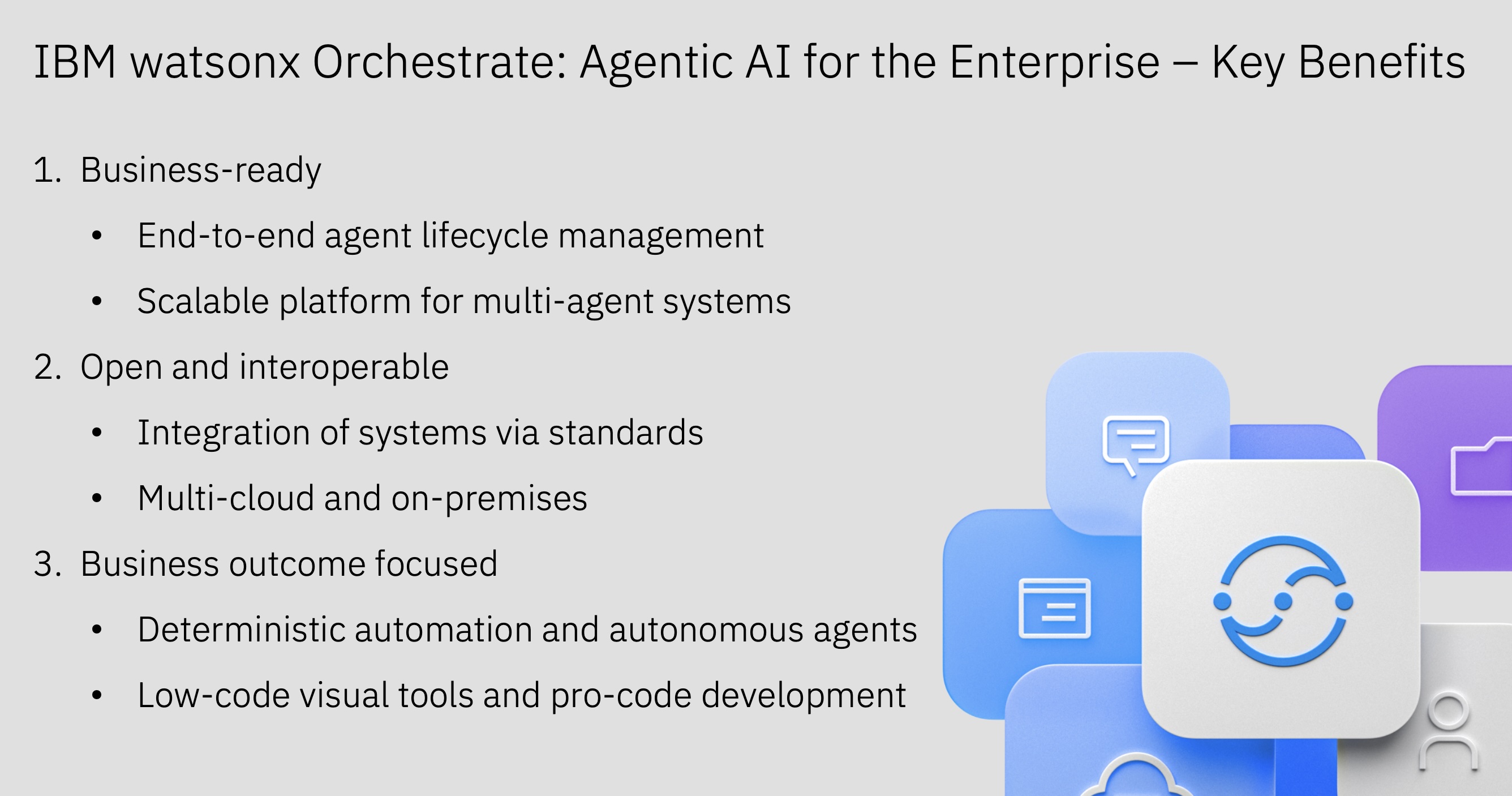
IBM watsonx Orchestrate provides agentic AI for the enterprise:
- Business-ready
- End-to-end agent lifecycle management
- Scalable platform for multi-agent systems
- Open and interoperable
- Integration of systems via standards
- Multi-cloud and on-premises
- Business outcome focused
- Deterministic automation and autonomous agents
- Low-code visual tools and pro-code development
Business-ready
There is a big difference in building agents for prototypes and demos vs building and operating agents for enterprises.
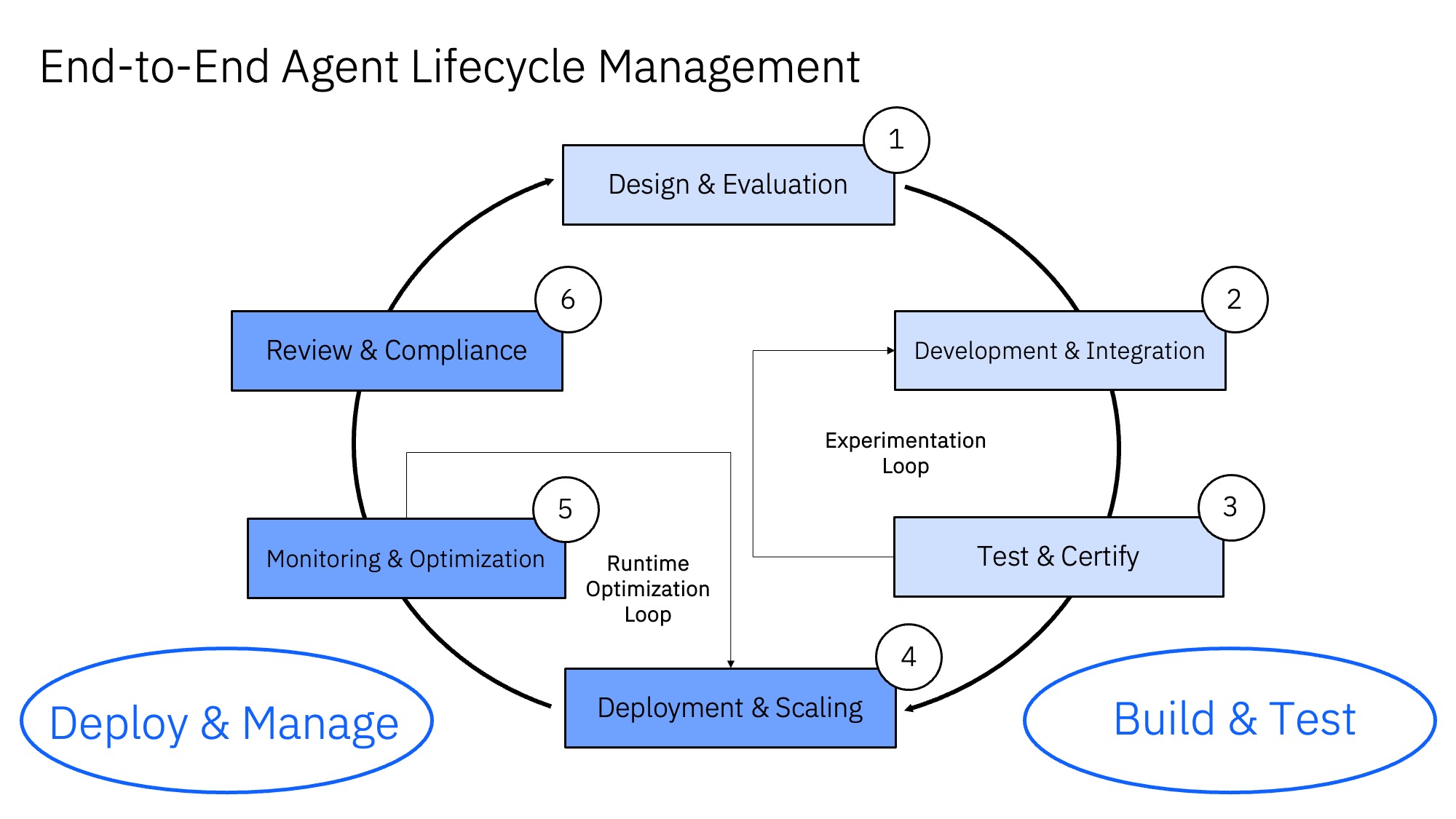
The agent lifecycle contains the development stages ‘Build & Test’, and the operation stages ‘Deploy & Manage’ which require different features.
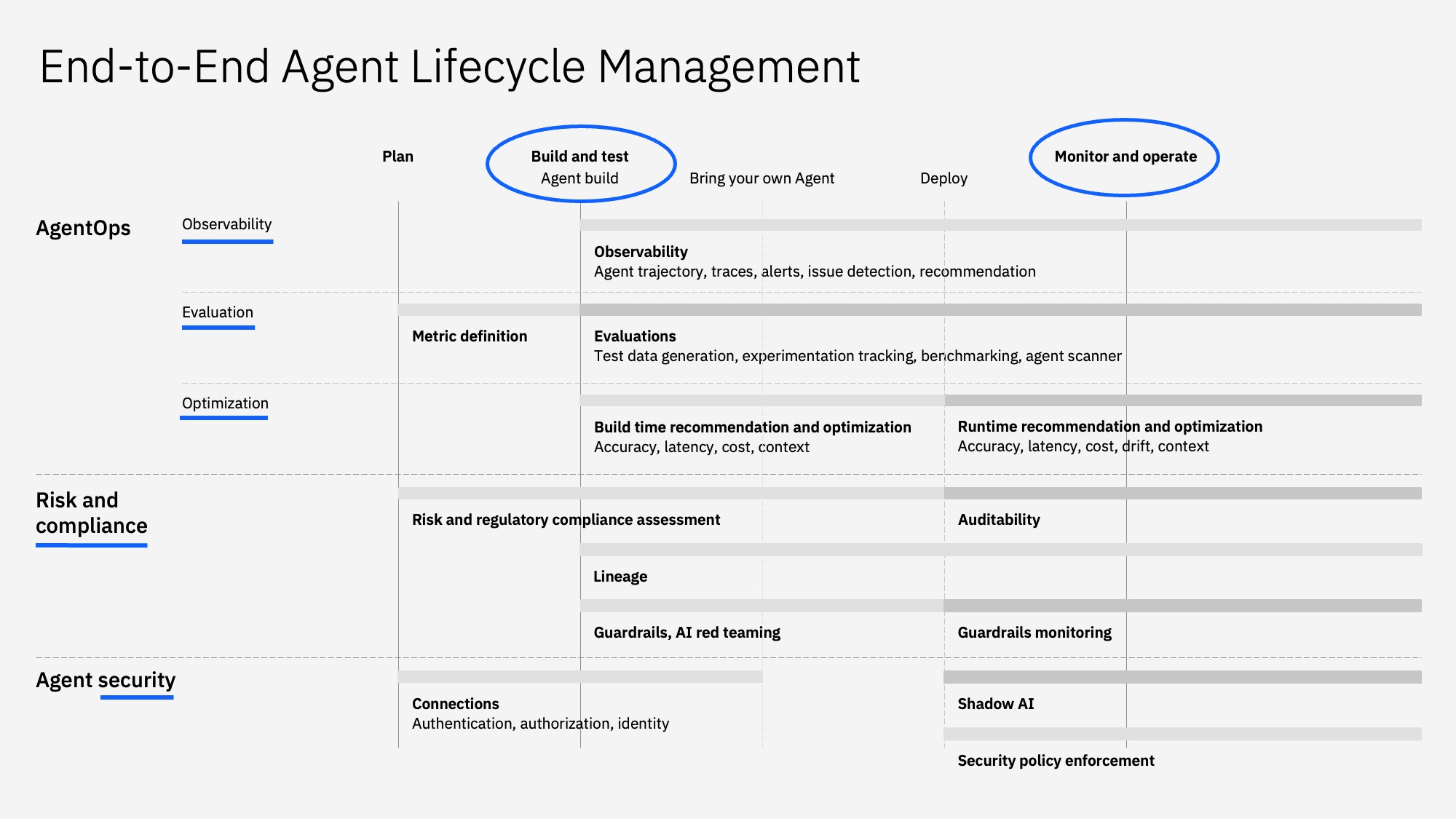
After the initial development many more capabilities are required in a business context: Security, observability, evaluation, optimization and compliance.
Platforms scale, use case-specific stacks do not.
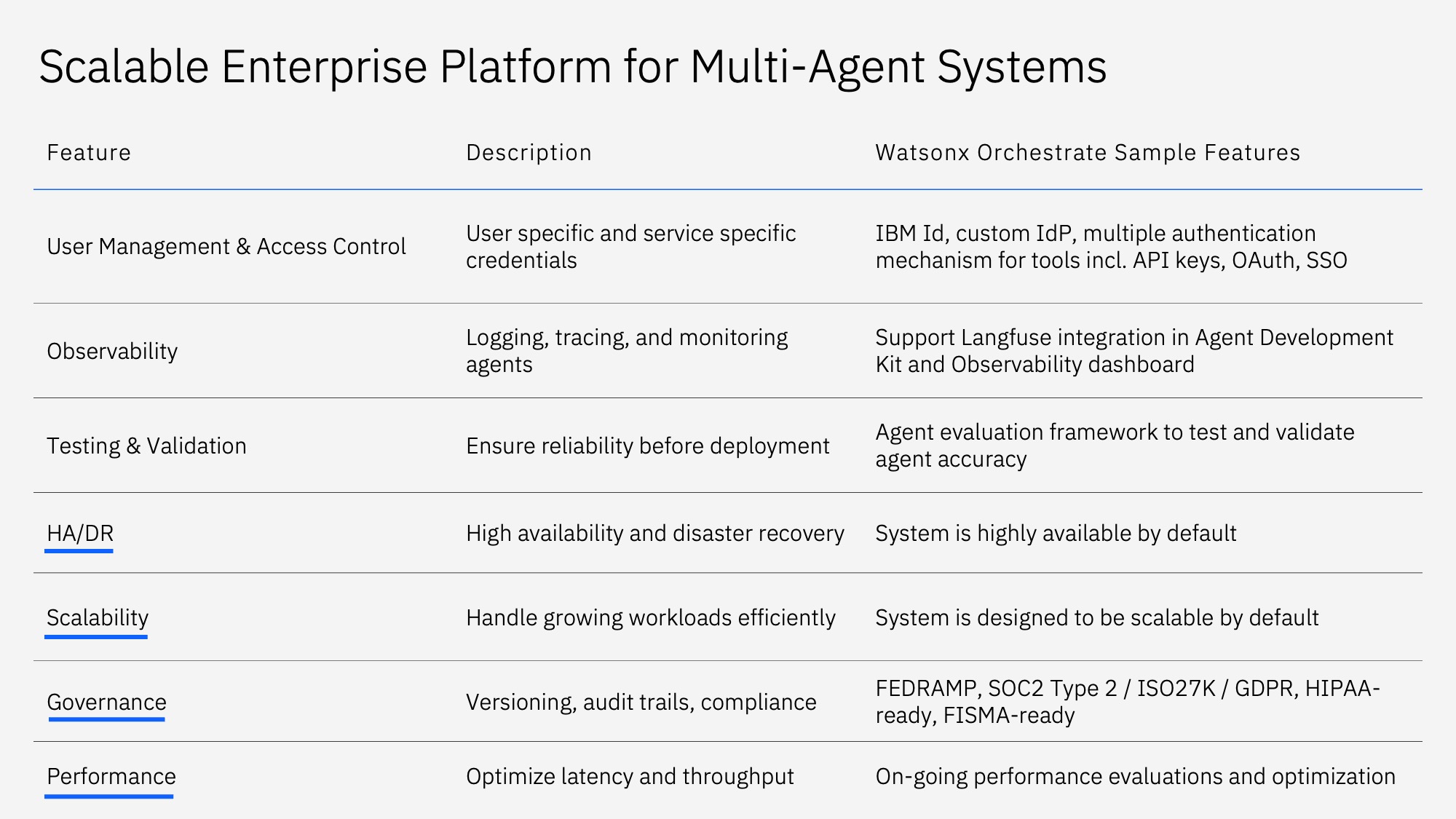
Scalable enterprise AI platforms need to provide high availability, scalability, governance, performance, and more.
Open and interoperable
Opinionated agent frameworks might be faster to get started, but open standards protect long-term strategic investments.
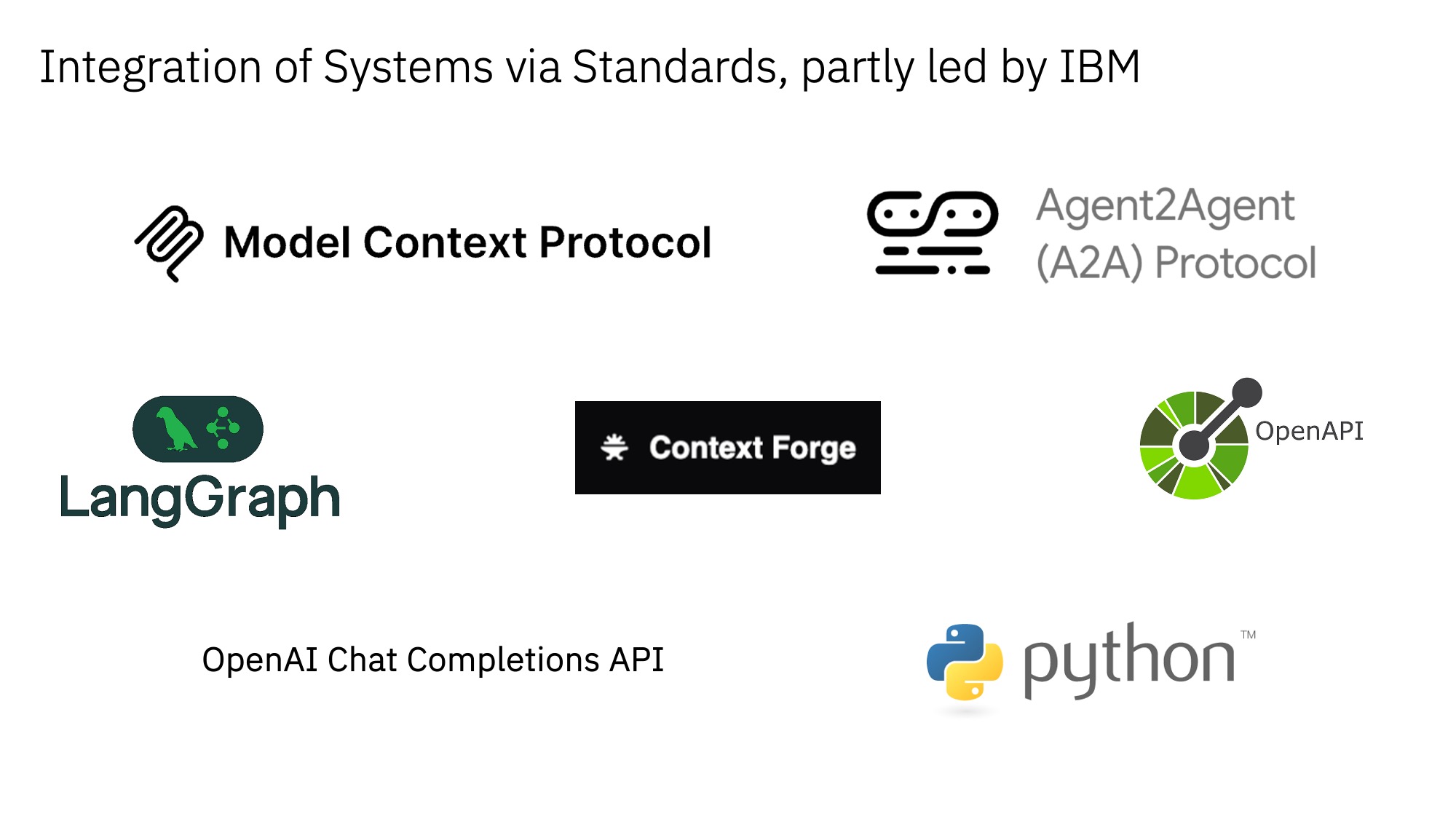
Watsonx Orchestrate leverages standards and open-source techniques like MCP (Model Context Protocol) and A2A (Agent 2 Agent) for multi agent systems. Additionally, IBM leads the open-source project Context Forge which is important to manage tools.
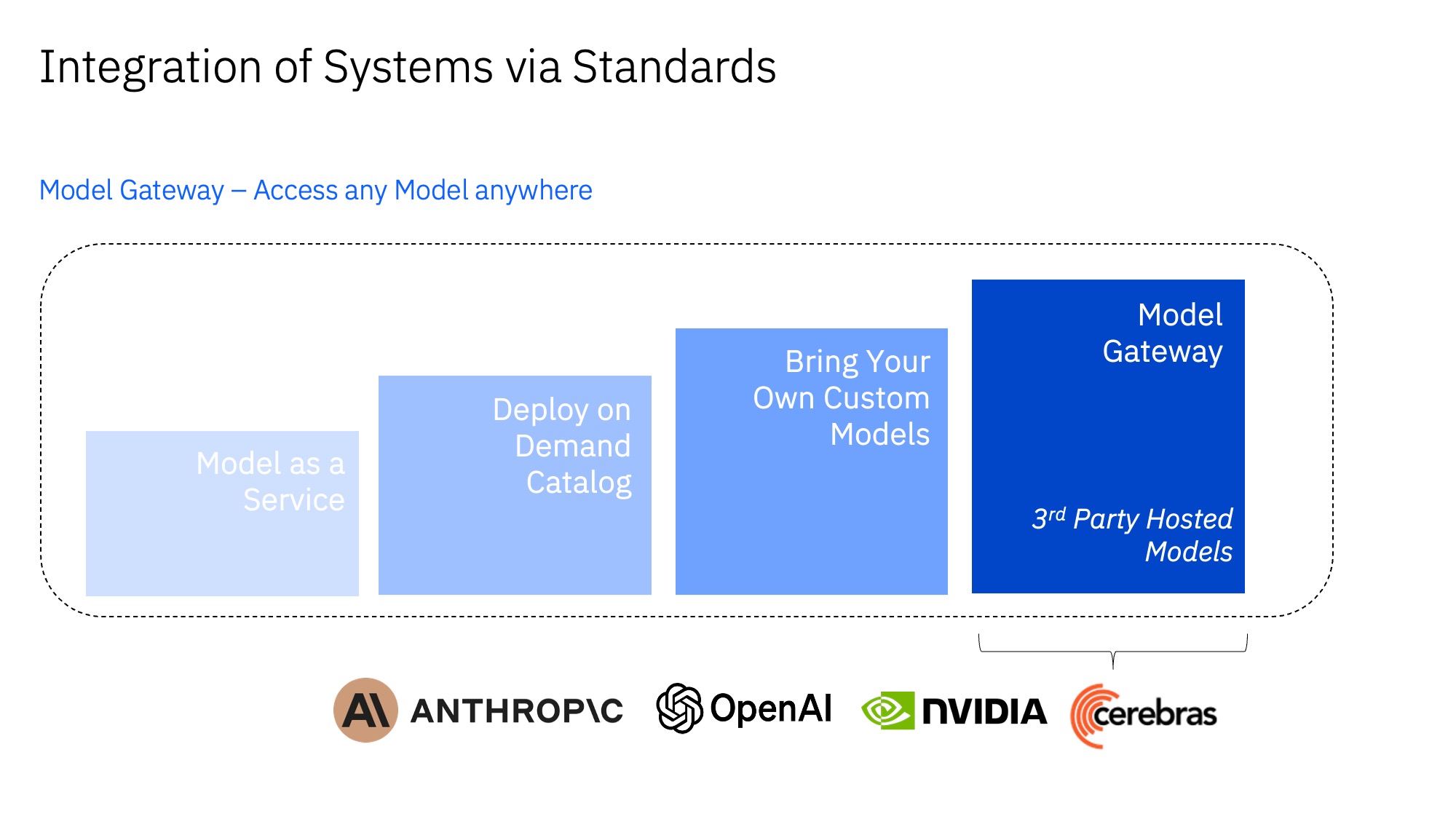
Watsonx provides models, custom models can be deployed and models hosted by other providers can be accessed.
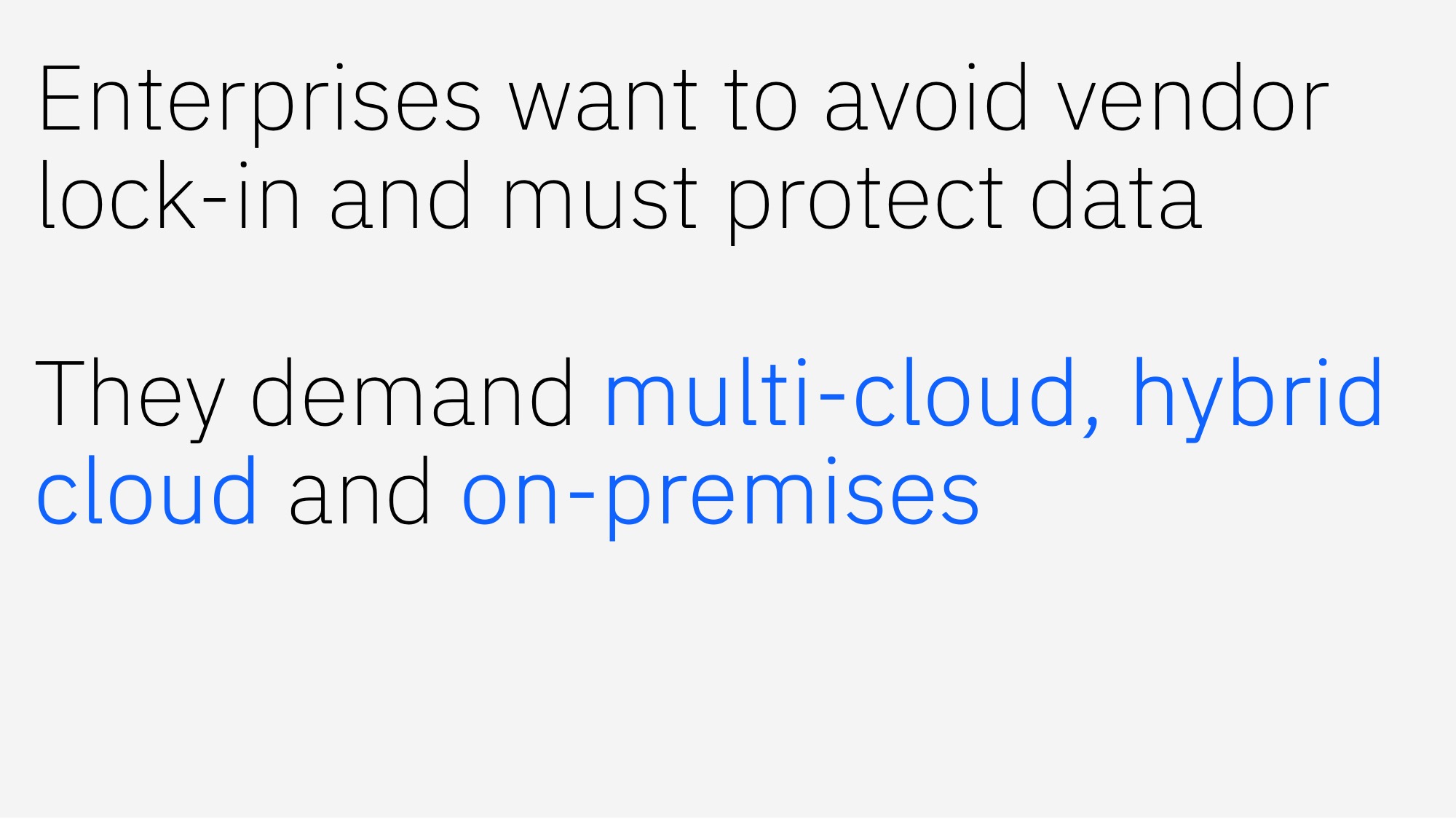
Enterprises want to avoid vendor lock-in and must protect data, they demand multi-cloud, hybrid cloud and on-premises.
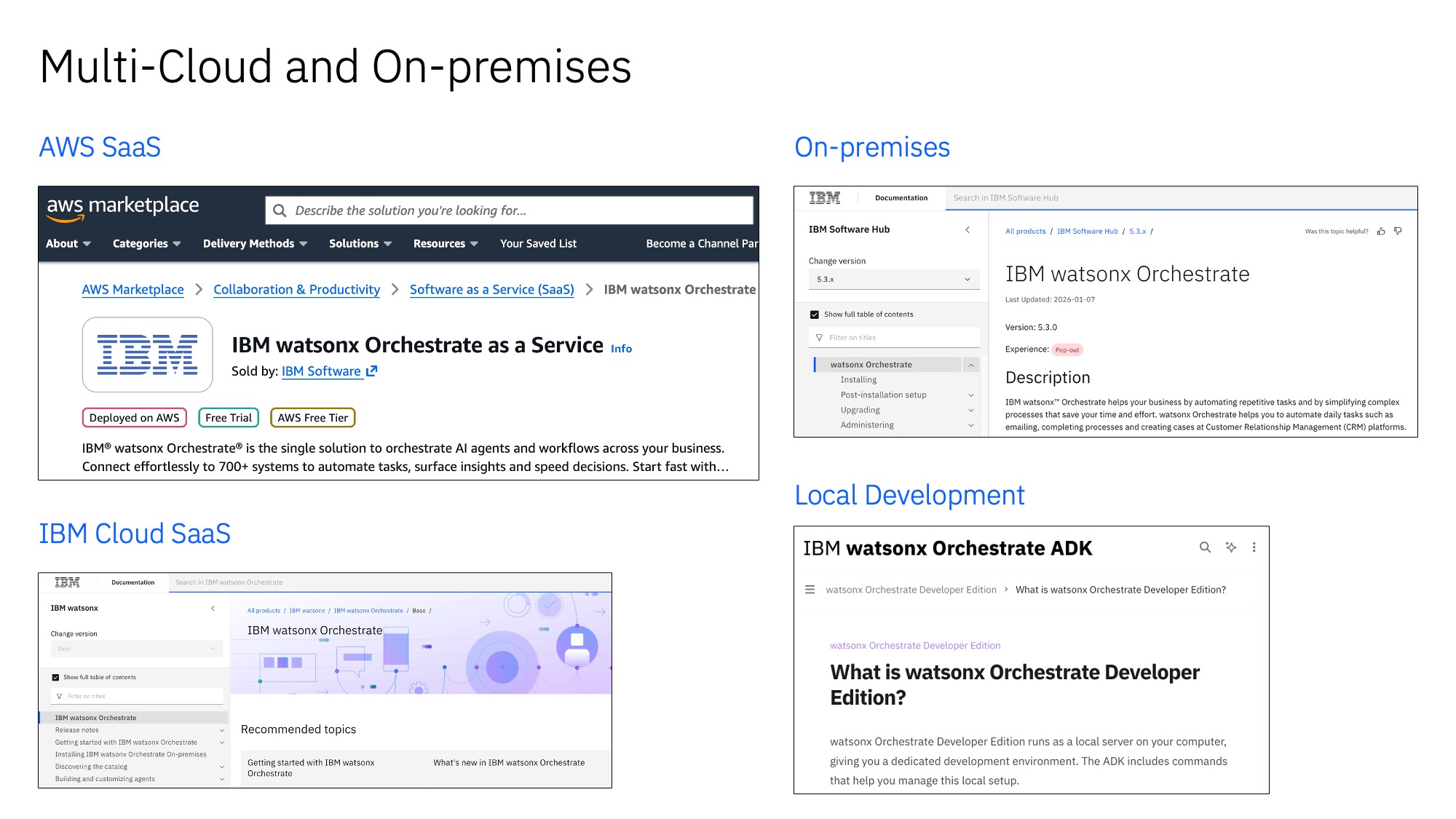
Watsonx Orchestrate is available on AWS and IBM Cloud as SaaS, there is an on-premises version, and developers can run it locally.
Business outcome focused
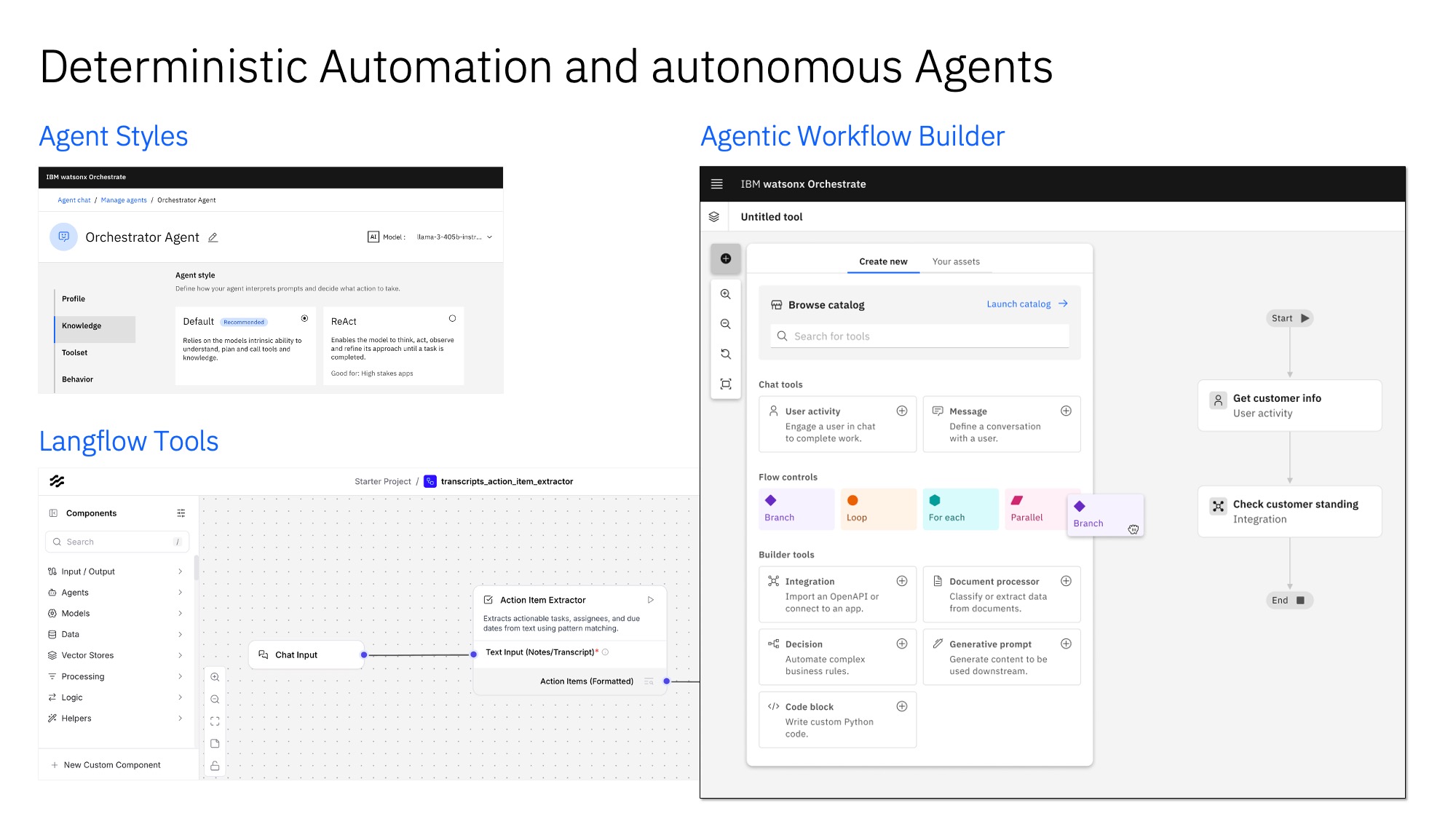
Agentic systems need to support autonomous agents and deterministic automation.
Watsonx Orchestrate comes with an Agentic Workflow Builder to develop deterministic flows with humans in the loop. Langflow can be used, for example, to build tools.
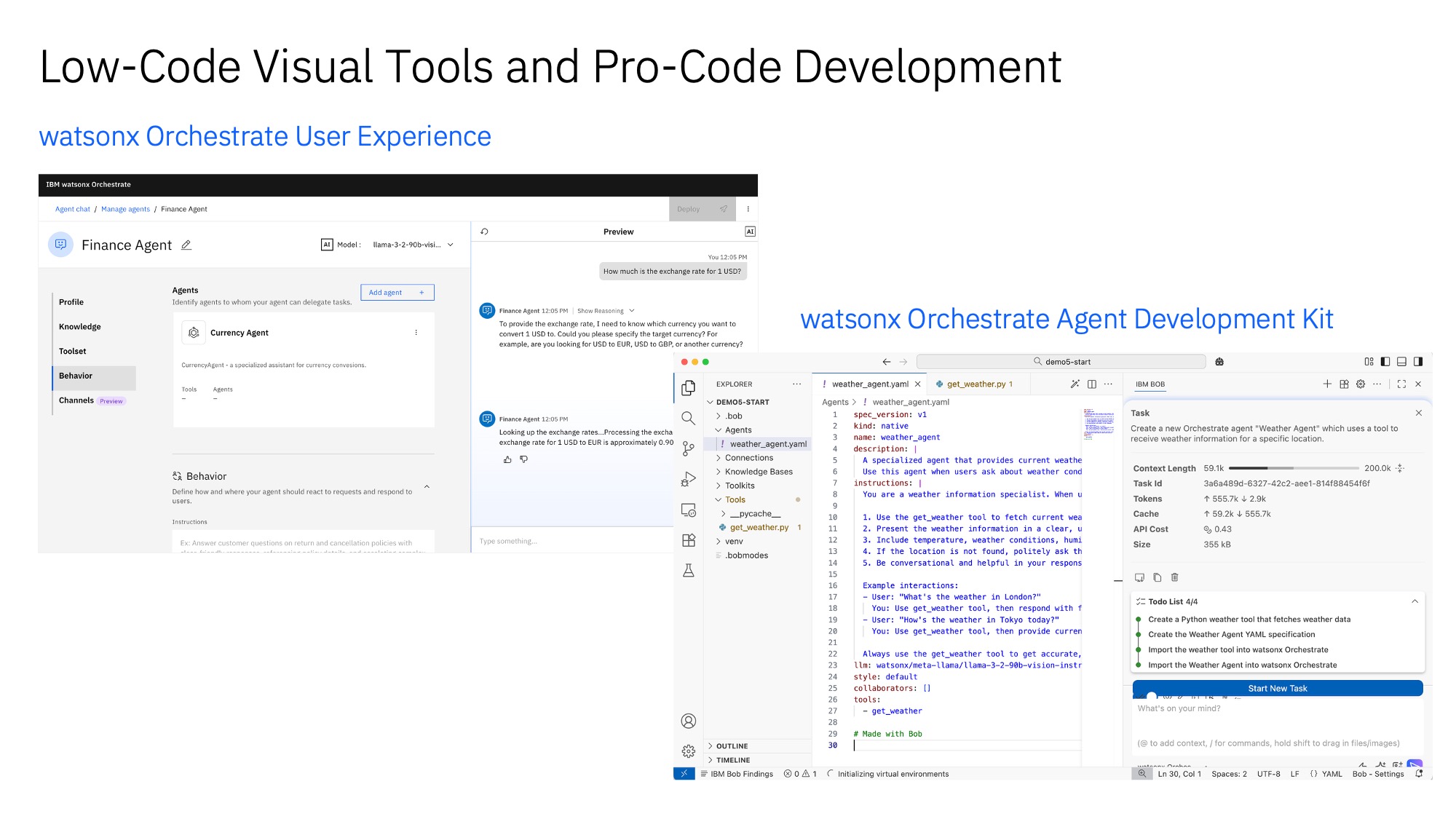
Enterprises require a flexible approach for building agents from no-code and visual tools to pro-code agent development.
In addition to the low-code Workflow Builder and Langflow, developers can leverage an Agent Development Kit, a CLI and APIs.
Next Steps
To find out more, check out the following resources: